

Today, Fake News Exposed presents another article by Dr. Joseph Ford Cotto. Dr. Cotto is the creator, host and producer of News Sight, delivering sharp insights on the key events that shape our lives. He publishes Cotto’s Digest, sharing how business and the economy really impact us all. During the 2024 presidential race, he developed the Five-Point Forecast which accurately predicted Donald Trump’s national victory and correctly called every swing state. Cotto holds a doctorate in business administration and is a Lean Six Sigma Certified Black Belt.
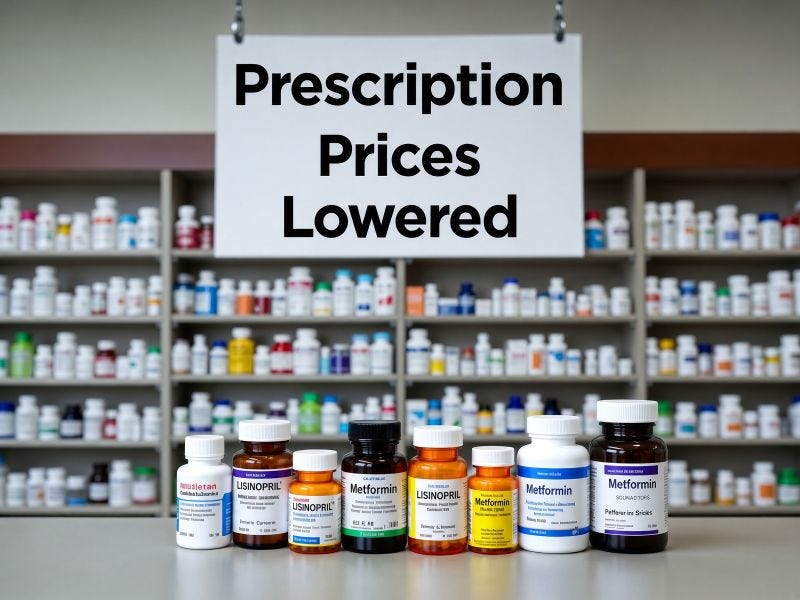
Americans Finally Stop Footing the Bill for the World’s Medicine
For decades, American families paid triple what patients in other wealthy countries spent for the exact same pills, made in the same factories.
That era is finished.
Fresh government figures show prescription drug prices recorded their steepest annual decline in more than 60 years, the biggest drop since 1963.
The numbers do not lie.
Prescription drug prices have fallen 3.9 percent since President Donald J. Trump retook office. They have declined every single month of 2026. Nonprescription drugs are down 2.4 percent over the same stretch. Medical care commodities, the broader category that includes drugs, equipment and supplies, dropped 2.7 percent over the past year. In July alone, the prescription drugs index fell another 0.8 percent.
This is not a market accident. It is the direct result of Most Favored Nation (MFN) pricing. MFN was created by Trump and quickly established itself as a hallmark of his second term. The results show that MFN is far from window dressing. It is real as the midsummer heat, being rigorously implemented by his administration.
Due to President Trump’s leadership, seventeen of the world’s largest drugmakers, representing roughly 86 percent of the branded market, have agreed to sell their products in the United States at prices no higher than the lowest paid by comparable developed nations:

Americans no longer bankroll cheaper medicine for Europe, Japan, and Canada while facing the highest stickers at home.
The executive order which Trump signed in May 2025 made MFN’s principle plain. The US accounts for less than five percent of the world’s population, yet has long funded around three-quarters of global pharmaceutical profits:

Foreign governments demanded deep discounts and American patients covered the difference.
That freeloading is over.
Patients are already feeling the difference through the TrumpRx platform, which is MFN’s direct-to-consumer platform. It has generated $700 million in savings for millions of Americans. GLP-1 drugs that once ran more than $1,000 a month now start as low as $149. Fertility treatments, inhalers, insulin, cholesterol medicines, and dozens of other high-cost drugs have been cut by 50 to 90 percent or more.
Couples facing in-vitro fertilization can expect to pocket more than $6,000 in savings. Uninsured GLP-1 users stand to save about $3,000 a year.
The Veterans Affairs Department is reaping even larger gains for those who served. So far in fiscal year (FY) 2026, the department has locked in $10.44 billion in pharmaceutical price reductions. That is nearly double the $5.23 billion recorded in the last full year of the Biden-Harris administration and well above the $7.99 billion secured in FY 2025. Lower prices mean more veterans treated and more resources freed for emerging therapies.
Longer-term projections confirm the scale.
Prospective MFN rules for new drugs are expected to generate $529 billion in domestic savings over the next decade, across private and public markets. Extending the lower prices to state Medicaid programs for existing drugs will save another $64.3 billion in federal and state dollars over the same period.
Politicians Talk About Drug Costs, Trump Acted Decisively to Lower Them
For all the noise, most often made during campaign season, nothing was delivered of MFN’s magnitude. Whether the White House, and Congress, were under red or blue control, “public servants” allowed foreign price controls to stand while American seniors, working families, and veterans absorbed the markup. Drugmakers collected the higher US revenue, all the while resisting real negotiation at home.
The result was predictable: families rationed insulin, delayed fertility treatment, or even skipped doses of life-saving medicine. That pattern of destruction has been broken through President Trump’s bold action. Once again, President Trump delivered on a campaign promise.
MFN does not punish innovation. It forces other wealthy nations to stop free-riding on American research and US wallets. Trade leverage and pricing commitments now work together. Foreign governments face hard, sustained pressure to pay fair value while manufacturers gain bargaining power abroad. That combination equalizes prices by pulling American costs down and foreign costs up.
The human stakes are concrete.
A parent no longer chooses between a child’s inhaler and the mortgage. A veteran receives the full course of treatment without the federal government stretching its budget thin. A couple pursuing fertility treatment sees the price cut in half or more. These are not abstract percentages. They are monthly budgets that finally make sense.
Critics who spent years defending the old system have gone quiet. They once insisted that any serious attempt to align American prices with the rest of the developed world would destroy research or empty pharmacy shelves. The data now show steady monthly consumer cost declines, massive savings for Uncle Sam, and hundreds of billions of dollars projected over the coming decade.
The predicted collapse never arrived.
Americans have subsidized the world’s medicine long enough. Far longer than enough, actually. The largest prescription-drug price drop in six decades proves that change, which voters may credibly believe in, is both possible and already underway. Patients are no longer the last in line. Nor are they the ones who pay soaring costs so everyone else can pay less. The bill is finally being shared more fairly, and American families are keeping more of their own money as a result.
Regrettably, beyond what words can describe, Americans once rationed insulin. They skipped fertility treatments. They watched veterans stretch razor-thin budgets. All this happened while foreign patients paid pennies for the same medicines. Now, those same Americans see proof of tangible progress, secure in the realization that more will follow.
President Trump has brought the largest prescription-drug price collapse in more than 60 years:

Something long thought to be impossible has arrived. No amount of denial can erase the monthly savings, the $10 billion already secured for former servicemen, or the hundreds of billions still coming.
This time the bill was finally sent where it belonged, and American families are keeping the change.
The July report made their progress, however uneven, undeniable. Hospital services rose 0.5 percent and physicians’ services rose 0.2 percent, even as prescription drugs fell another 0.8 percent that month. Medical care overall still climbed 1.7 percent over the year, while medical care commodities dropped 2.7 percent. Those commodities have long crushed family budgets.
Those price drops now make a fiscally sustainable Medicare expansion for anti-obesity drugs possible after patients paid more than $1,000 a month. Veterans Affairs, with $10.44 billion in pharmaceutical reductions this fiscal year, has enrolled more than 215,000 additional veterans. It also opened 40 new clinics since January 2025. Both happened because list prices no longer swallow the departmental budget.
Hundreds of billions more in long-term savings remain as new drugs launch at Most Favored Nation prices instead of American-only markups. Direct-to-consumer discounts are slated to count toward deductibles so the savings are real, not cosmetic. A mother choosing between an inhaler and groceries, a veteran delaying a prescription refill, a couple abandoning fertility treatment no longer have to live that way.
The largest drug-price drop in six decades is insulin in the cabinet, a pregnancy that can proceed, and a healthcare appointment that happens. For decades, Americans paid the world’s premium. After years of lip service from politicians who refused to actually do anything about prescription medication costs, President Trump stopped the abuse. Be sure to remember that in November.
(Be sure to give Dr. Cotto a follow on his social media account at X where you will find his podcast episodes, links to his books and articles, along with his daily posts containing everything from political analysis to economic analysis and more.)